
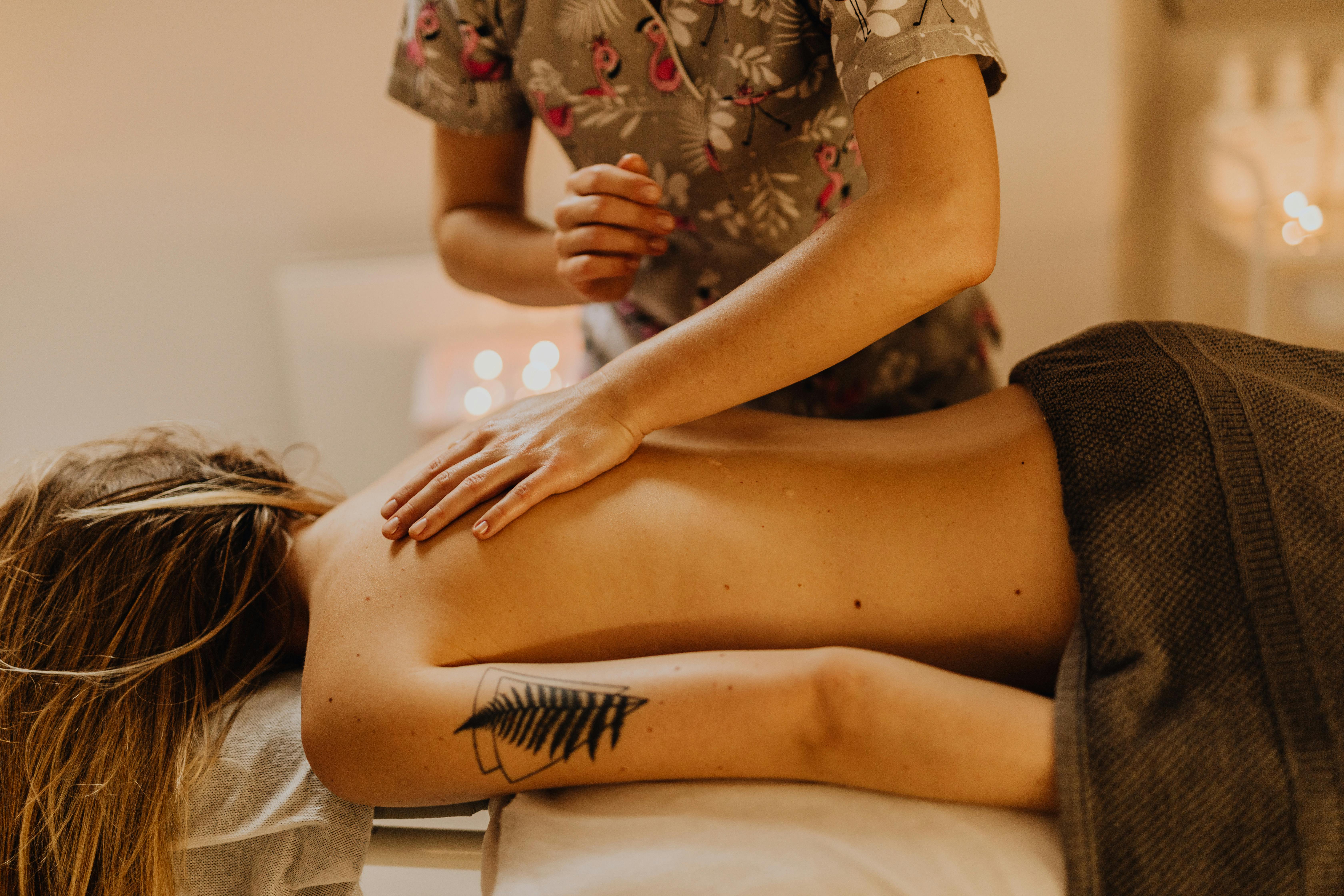
Spa menus list scrubs and wraps side by side at similar prices, and clients often treat them as interchangeable. They act on the skin through unrelated mechanisms and produce different sensations for that reason.
What a scrub is doing physically
A scrub combines an abrasive particle with a carrier, usually oil, cream or a salt slurry. The therapist moves that mixture across the skin under light pressure in overlapping passes.
The particles dislodge loosely attached cells from the outermost layer. Nothing dissolves and nothing penetrates; the action is friction applied briefly and then rinsed away entirely.
Particle hardness and edge shape determine how aggressive the treatment feels. Sugar dissolves as it works and softens, while salt stays angular and mineral grains stay harder still.
What a wrap is doing instead
A wrap applies a product across the body and then encloses it, typically with sheeting and a thermal blanket. The enclosure is the active part of the treatment.
Covering the skin prevents evaporation, so the applied material stays wet and in contact for the full duration rather than drying within minutes on open skin.
Trapped body heat raises skin temperature, which increases local blood flow and softens the surface. The client experiences that as warmth and heaviness rather than as scrubbing.
Why scrubs come first in a sequence
Spa protocols almost always place exfoliation before any wrap or applied treatment, and the ordering is functional rather than traditional in origin.
Removing loose surface cells gives the following product a more uniform surface to sit against, so the material spreads evenly instead of collecting on rough patches.
The reverse order wastes the wrap. Scrubbing after a wrap removes much of what the wrap deposited, which is why menus never sequence them that way.
Where marketing outruns the mechanism
Wraps are frequently sold with detoxification or slimming language, and both claims describe outcomes the treatment cannot deliver.
Any immediate reduction in measured circumference after a heated wrap reflects fluid movement, which returns as the body rehydrates over the following hours.
Elimination of waste products is handled by the liver and kidneys. Skin contributes very little to it, and no applied material redirects that work.
Who should approach these services carefully
Heat-based wraps place a load on the circulatory system, and prolonged enclosure raises core temperature. Pregnancy, cardiovascular conditions and pregnancy-related complications all change that calculation.
Scrubs are inappropriate over broken skin, active sunburn, fresh shaving irritation or recent waxing, because the barrier is already compromised in those areas.
Skin that stays red, painful or swollen hours after any spa service warrants a physician's assessment rather than a follow-up appointment at the spa.