
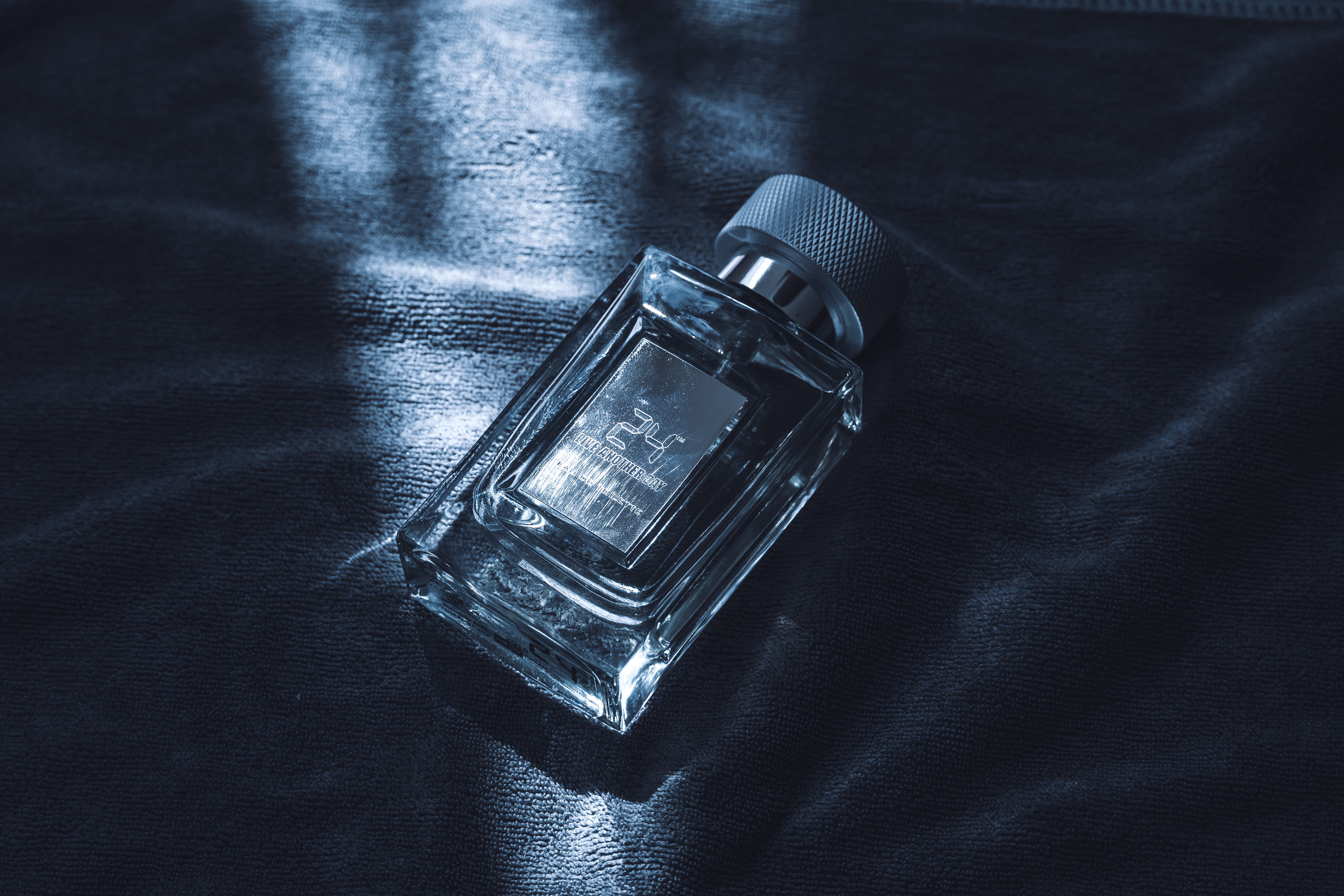
A finished perfume can contain a very large number of materials, yet it is described in a handful of impressions. The bridge between the two is the accord.
An accord is a blend that reads as one thing
An accord is a combination of several materials balanced so that none is individually identifiable and the result registers as a single new smell.
The comparison usually made is to a musical chord, where separate notes played together produce something the ear hears as one sound rather than three.
Working in accords lets a perfumer think in terms of a dozen building blocks rather than hundreds of individual raw materials.
Many familiar smells do not exist as materials
Some natural sources cannot be extracted at all. Lily of the valley, peach and many other scents yield nothing usable by distillation or extraction.
Those smells are therefore reconstructed as accords from unrelated materials that, in the right proportion, produce the impression of the original.
This is why a perfume can smell distinctly of something that has never been in the bottle, and why the ingredient list rarely explains the experience.
Accords are built to evolve together
Because components evaporate at different rates, an accord that is balanced on paper can fall apart within an hour on skin.
Perfumers therefore construct accords with the whole progression in mind, selecting materials whose volatilities keep the impression coherent as it fades.
Fixatives and heavier materials are used partly to slow the lighter components, holding the balance for longer than it would otherwise survive.
Naturals and synthetics do different jobs
Natural extracts are themselves complex mixtures containing many compounds, which gives them richness but also variability between harvests.
Synthetic materials are single compounds or defined mixtures, so they behave consistently and can supply effects with no natural equivalent at all.
Most modern perfumery uses both, with synthetics providing structure and reliability while naturals provide depth that is difficult to reconstruct.
Why families are a rough guide only
Categories such as floral, oriental, chypre and fougère describe recognisable arrangements of accords rather than specific ingredient lists.
A fougère, for instance, refers to a structural relationship between certain elements that has been reinterpreted continuously since it was first assembled.
These labels are useful for orientation but describe architecture rather than smell, which is why two fragrances in the same family can be entirely unalike.
The classifications also predate most modern synthetic materials, so newer compositions frequently sit between categories and are assigned to one largely by retail convention.